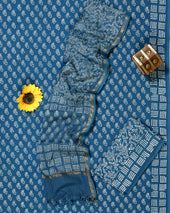
Traditional Sanganeri Textiles: Chunari, Phadad, Safa and Palangposh
By Hitesh Sharma, Founder, Shree Srishti Textile, Sanganer, Jaipur · Fourth-generation hand block printer · Updated 22 October 2026
Colours were made for communities
The book records that Sanganer's Chhipas printed designs for each community's taste. Royal and feudal families got attractive designs in yellow, red, blue, green and pink; everyday wear for common people was printed in black and red. In Bagru, colour even showed identity – the Mali community preferred green, Meena women blue and red, Brahmin women yellow and red, and Rajput women wore pink and yellow ghaghra-lugdi.
15 traditional Sanganeri products
| Product | What it is | Detail from the book |
|---|---|---|
| Kaali chunadi | Women's odhni | 3 m × 2 m on malmal; black outline, red datai, dyed to give a black effect; loved by Bhil, Gujar and Mali women |
| Raati chunadi | Red odhni | About 2.75 m × 2 m on malmal; red/begar bhaants from aal, green datai |
| Kaagi dupatta | Dupatta | Printed only on pallu and border, black in the middle; worn by the Bhil community of eastern Rajasthan |
| White safa | Turban | 1 gaj × 10 gaj of good khadi, elephant bhaant outlined in black on the pallu; worn mainly by the Gujar community; also sold in Bikaner and Jodhpur |
| Gooltoor safa | Turban | Famous across Rajasthan |
| Mein ki phadad | Ghaghra cloth | Popular with Bhil, Jat and Gujar women; printed by the gaar or Dabu method |
| Dhaniya chakri phadad | Ghaghra cloth | Used for ghaghras of Meena women |
| Daakh-bel phadad, sabzi-zardi phadad, hara dhaniya phadad | Ghaghra cloth | Named after their motifs and colours |
| Naagin-sapera bichhavani | Bedspread | 60 × 90 on cotton; black borders on all four sides, red snake-charmer buti in the centre; sold in other states and abroad |
| Khokha palangposh, Dabu palangposh | Bedcovers | Classic Sanganer home textiles |
| Dabu razai | Quilt | Mud-resist printed |
| Jajam | Large floor spread | For gatherings |
| Angochha | Cotton towel/shoulder cloth | Everyday use |
| Laal-surkh saree, hara dupatta | Sarees and dupattas | Bright reds and greens |
| Chaupad ka chaukara | Game cloth | Printed chaupad board |
Where these traditions live on today
The book notes that Sanganer's output gradually moved from village and community wear to cloth for cities and export – stitched garments, bedsheets, pillow covers, curtains and dress material. The same motifs and colour sense now appear in our wholesale range:
- Chunadi and odhni prints → hand block sarees and Kota doria dupattas
- Phadad and dress cloth → hand block suit materials
- Palangposh and bichhavani → hand block bedsheets
 Pink Bagru Jaal Kota Doria Saree₹970 per set · wholesale
 Maroon Black Pallu Kota Doria Saree₹970 per set · wholesale
 Lilac Floral Buti Kota Doria Saree₹970 per set · wholesale
 Olive Green Floral Hand Block Suit₹730 per set · wholesale
 Lal Booti Stripe Border Bedsheet₹1,050 per set · wholesale
 Shyam Jaal Hand Block Bedsheet₹1,050 per set · wholesale
FAQ
What is a phadad?
Printed cloth for a ghaghra (skirt), named after its motif – such as mein ki phadad or dhaniya chakri phadad.
What is the difference between kaali chunadi and raati chunadi?
Kaali chunadi gives a black effect with a black outline and red datai; raati chunadi is red, printed with aal-based red and green datai. Both are printed on malmal.
What is a bichhavani?
A printed bedspread or floor spread. The naagin-sapera bichhavani, 60 × 90 on cotton, is one of Sanganer's best-known designs.
Which colours were traditionally used in Sanganeri print?
Mainly red and black on a white ground for everyday wear, and yellow, red, blue, green and pink for royal families.