Sanganeri Hand Block Printing Process: 12 Traditional Steps From Our Family's Craft Manual
By Hitesh Sharma, Founder, Shree Srishti Textile, Sanganer, Jaipur · Fourth-generation hand block printer · Updated 22 October 2026
Why Sanganer became the centre of block printing
Block printing in Sanganer began at the end of the 17th century, when Chhipa (printer) families from Gujarat settled here, and it flourished through the 18th century. Our family's book records that the printers found a special quality (taaseer) in the water of the Saraswati river: its minerals made vegetable colours brighter.
In Indian Art at Delhi (1902–3), Sir George Watt described Sanganer as the capital of India's printing craft for its artistic imagination and technique. Sanganer's printers made designs for royal families in yellow, red, blue, green and pink, and for everyday wear in black and red – the palette still linked with Sanganeri print today.
The 12 traditional stages of Sanganeri printing, in order
The book lists the full traditional sequence as: harisarna, dhulai, tapai, washing again, sukhai, peela karna, drying, peela jhadna, printing (gadh, rekh, chirai, datta), finishing, maanj, simtai and kundigiri. The main stages work like this:
| # | Stage (Hindi name) | What happens | Recipe / detail from the book |
|---|---|---|---|
| 1 | Harisarna (हरिसारना) | Raw (kora) grey cloth is soaked in cow-dung water, wrung and set aside to loosen the mill starch (maandi). | About 5 kg cow dung per 100 m of cloth. |
| 2 | Dhulai (धुलाई) | Next day the cloth is washed in clean water. The starch comes out fully and the cloth turns soft enough to take colour. | Repeated if needed. |
| 3 | Sun bleaching | Cloth is spread on open ground, sprinkled with water and kept damp in the sun until it turns white. | If not white in one day, repeated next day. |
| 4 | Peela karna (पीला करना) | Cloth is soaked in harda (myrobalan) so colours bind. The edge is beaten on a clean stone and it is dried in the sun, which sets the harda. | About 3 kg harda per 100 m, mixed with tilli (sesame) oil and water. |
| 5 | Rekh (रेख) | The outline of the design (bhaant) is printed with the outline block on a printing table (paat). | In syahi (black) or begar (red). |
| 6 | Chirai (चिराई) | The inner outline (bhitri rekh) is printed in a contrasting colour. | Separate block. |
| 7 | Datai (डटाई) | Fill colour is printed over the outline with the datta / gadh block. | One block per colour. |
| 8 | Pachhdai (पछडाई) | Printed cloth is rinsed in two separate tanks (haud) to remove the gum, moved end to end so it doesn't bunch. | Then washed and sun-dried. |
| 9 | Ghaan rangna (घान रंगना) | Cloth is boiled in a copper vessel (taambdi) with aal colour and dhawadiya flowers, moved up and down (chaal). This makes black fast and turns begar red, and clears stains. | Taken out when it reaches the boil. |
| 10 | Resist (med-paste), when needed | Printed areas are covered with resist before the ground colour (jaali) is applied. | Lime, clay, gum and wheat; in Sanganer also pine resin, beeswax and desi ghee. |
| 11 | Washing and drying | Final washes and sun drying. | By the dhobi, in open ground. |
| 12 | Finishing (maanj, simtai, kundigiri) | Finishing, folding and beating the cloth smooth. | Final form traditionally given by hand and machine. |
Two practical points from the book matter for buyers. First, Sanganeri butis are printed at small, even intervals, so a good piece shows a steady rhythm with tiny natural variations. Second, fine and multi-colour bhaants were traditionally printed by men, while women printed bold bhaants, rekh and Dabu work – every colour is a separate pass by hand.
Natural colour recipes: syahi, begar and more
The book gives exact traditional recipes. These numbers are rarely written down anywhere else:
| Colour | Made from | Quantity and time |
|---|---|---|
| Syahi – black | Iron horseshoes (ghode ki naal) + jaggery (gud) in water, in an earthen matka | 20–25 horseshoes + 0.5 kg gud; ready in 1 week |
| Begar – red | Alum (phitkari) + gum + red ochre (geru) in a copper vessel | 1 kg alum + 250 g gum + 100 g geru; ready in 3 days |
| Fast red / black | Aal (alizarin) – pounded aal wood | Used in ghaan rangna |
| Yellow | Harda; golden yellow from kasumba (safflower); light yellow from pomegranate rind (nashpal) and harsingar flowers | — |
| Blue | Neel (indigo) | — |
| Green | Turmeric (haldi) over indigo | — |
Gum or guar gum thickens the colours, and dhawadiya flowers give them cleanness and depth.
The wooden blocks (thappe) and their makers
Blocks are carved by the Batkade (also Kharadi) – literally those who cut with the adze and chisel. The book calls the printer and carver a choli-daaman pair: one cannot work without the other.
- Woods: sheesham (hard, long-lasting), gurjan from Sawai Madhopur (soft, best for fine outlines), teak; mango and ardu only for handles.
- Seasoning: wood is dried 3–4 years before carving.
- Depth: Sanganeri blocks are carved 4–5 mm deep; Farrukhabad blocks 2–3 mm.
- One block per colour: a 3-colour design needs at least 3 blocks – rekh, chirai and datta.
- Names on the floor: rekh, datta, chirai, gadh, haasiya, boondi, boota, paarcha, bel, jaal, gola.
Want to check whether a fabric is truly hand printed? See our guide on hand block vs screen print.
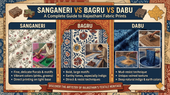
Sanganeri vs Bagru: how to tell them apart
| Sanganeri | Bagru | |
|---|---|---|
| Ground | White (safed zameen) | Dyed ground – red, kathai (catechu brown), indigo |
| Motif style | Fine (baariki), delicate butis, flowers leaning left | Bold (motai) motifs |
| Colours | Mainly red and black | Many colours; Dabu and indigo work |
| Classic motifs | Gulab, kamal, keri, naachte mor, naagin-sapera | Hara dhaniya, daakh, chaubundi, bansli flower |
For Dabu mud-resist and natural-dye fabrics, read our Bagru and Dabu wholesale guide.
Buy Sanganeri hand block print wholesale
 Indigo Buti Hand Block Cotton Suit₹730 per set · wholesale
 Teal Buta Hand Block Cotton Suit₹730 per set · wholesale
 Red Tree Buta Hand Block Cotton Suit₹730 per set · wholesale
 Sage Leaf Booti Hand Block Bedsheet₹1,050 per set · wholesale
 Grey Dense Jaal Hand Block Bedsheet₹1,050 per set · wholesale
 Terracotta Guldasta Hand Block Bedsheet₹1,050 per set · wholesale
FAQ
What is the first step of Sanganeri block printing?
Harisarna – soaking grey cloth in cow-dung water to loosen the mill starch, followed by washing and sun bleaching the next day.
Why is harda used in hand block printing?
Harda (myrobalan) is a natural mordant. It makes the cloth take and hold the printed colours; traditionally about 3 kg is used per 100 m.
What do rekh, chirai and datai mean?
Rekh is the outline print, chirai the inner outline in a contrasting colour, and datai the fill colour printed over it. Each uses its own block.
How is black colour (syahi) made traditionally?
By soaking 20–25 iron horseshoes with half a kilo of jaggery in water in an earthen pot for about a week.
What is the difference between Sanganeri and Bagru print?
Sanganeri prints have a white ground with fine red and black motifs; Bagru prints have dyed grounds, bolder motifs and Dabu mud-resist work.